

AI content is everywhere today. It’s quick, easy to use, and super powerful, but let’s be real… a lot of it still feels the same. It can sound flat, stiff, or even a bit robotic.
Speed is great, but it often leads to the same old “robotic writing” problem.
Matters more than ever because:
- Google’s E-E-A-T rewards real experience and real voices
- Readers click away fast when content feels machine-made
- Brands lose trust when their message sounds dull or lifeless
The good news? You can turn AI-written text into something that feels real, friendly, and truly human once you know the right tricks.
In this guide, you’ll explore 10 easy strategies to know how to humanize AI content, along with the top tools that help you do it quickly and at scale.
What Does “Humanize AI Content” Actually Mean?
Humanized content is writing that reads like it was crafted by a person, complete with personality, nuance, emotion, and context. It’s the difference between reading a Wikipedia entry and having a conversation with a knowledgeable friend over coffee.
The Stakes Are Higher Than You Think
When your content sounds robotic, it’s not just an AI detector you’re worrying about; you’re risking much more:
- Lower engagement: People leave fast when the text feels cold
- Loss of trust: Readers know when they’re being spoken at instead of with
- Weak SEO: Google boosts content that shows real experience
- No brand identity: If your content sounds generic, people forget you
Common Signs of Purely AI-Generated Text
You’ve likely noticed these warning signs before:
- A stiff, formal tone that reads like a corporate announcement
- Sentences that repeat the same rhythm or structure
- Vague, one-size-fits-all lines like “In today’s fast-changing world…”
- No personal stories, no real examples, just plain facts
- Too many buzzwords such as “synergy,” “leverage,” or “paradigm shift”
What Humanized Content Looks Like:
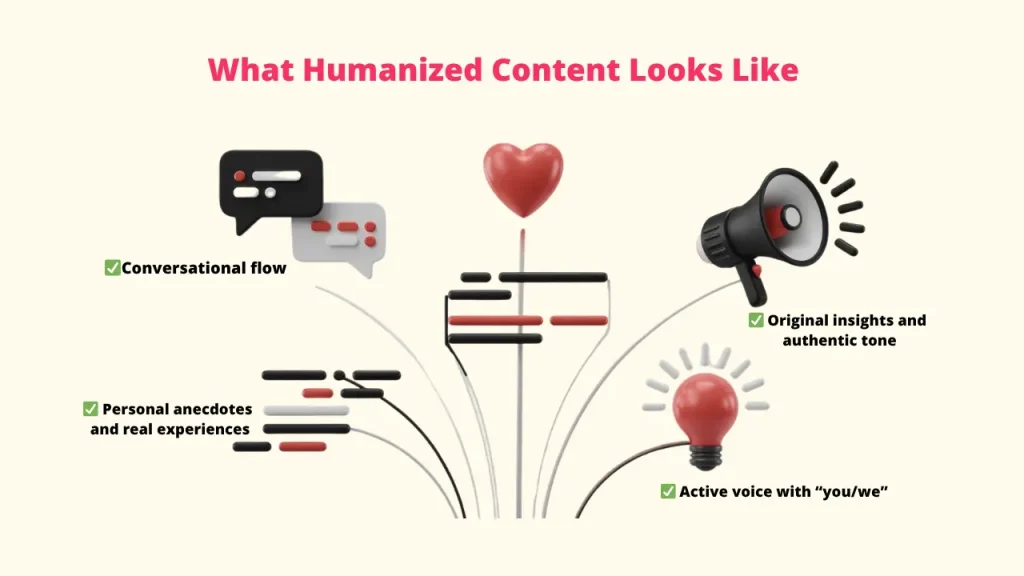
✅ Conversational flow
✅ Personal anecdotes and real experiences
✅ Varied sentence lengths
✅ Active voice with “you/we”
✅ Original insights and authentic tone
10 Proven Strategies to Humanize AI Content
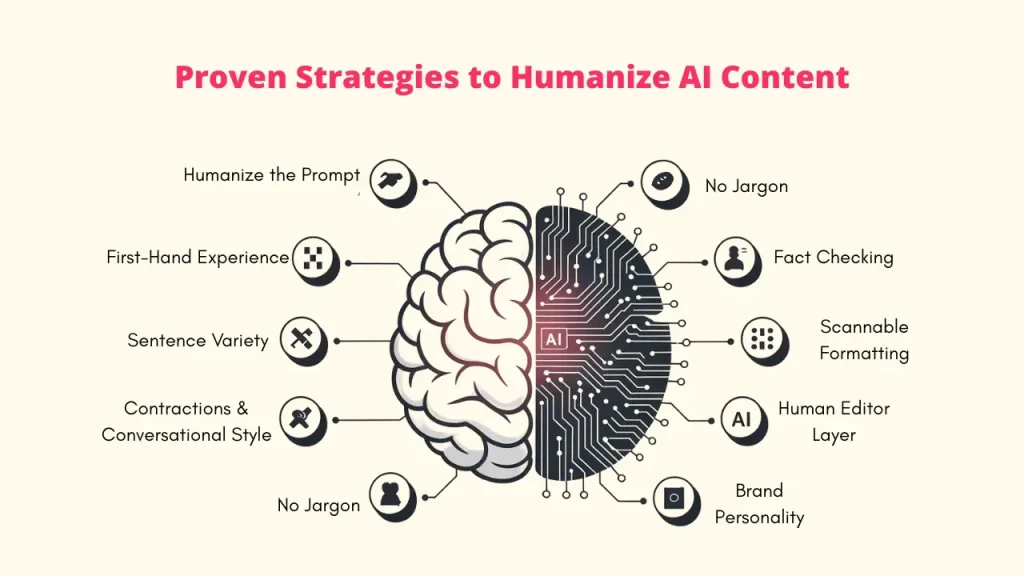
Use these strategies to ensure your brand voice always shines through and to keep it authentic. Humanize AI content with these ten ideas:
✅ Strategy 1: Humanize the Prompt, Not Just the Output
The output will be ambiguous if your prompt is unclear. You have to give AI clear instructions if you want it to sound more human.
Try this: Give the AI a persona and tone to follow.
For example: “Act like a marketer with 10 years of experience. Keep the tone casual and slightly witty.”
You can also tell the AI what to avoid so the AI content stays natural and fresh.
Sample Prompt You Can Use:
“Write like a marketer with 10 years of experience. Casual, slightly witty tone. No clichés. Avoid words like synergy, empower, or unlock.”
✅ Strategy 2: Inject First-Hand Experience (The E in E-E-A-T)
AI can write fast, but it can’t live your life. It has never launched a campaign, fixed a failed project, or learned from real mistakes you have made.
That’s what makes your brand voice powerful when you want to humanize AI Content.
Try this:
- Add a short personal story
- Use real numbers from your experience
- Include “I” and “we” statements to show real wins and lessons
These personal touches are what separate human writing from plain AI content.
Your own experiences are what genuinely humanize AI content and give it a sense of realism, even though AI tools like Blogi can assist you in rewriting drafts, discovering fresh perspectives, and identifying popular subjects.
✅ Strategy 3: Break the Monotony with Sentence Variety
Human writing has rhythm. It speeds up, slows down, and feels alive. AI content, however, often repeats the same sentence length over and over, which makes the text feel dull and robotic.
Try this:
Mix short, punchy lines with longer sentences to keep the flow natural and engaging.
And yes, starting a sentence with “and” or “but” can actually make your writing feel more natural and conversational. This simple rhythm shift helps you humanize AI Content with ease.
✅ Strategy 4: Embrace Contractions and Conversational Fillers
In this, you can see that formal language is one of the biggest signs of AI writing. Real people speak in a relaxed way and use short forms without thinking.
Try this:
- Use contractions everywhere they fit: “don’t,” “it’s,” “you’re.”
- Add natural transitions people use in real conversations, like “Here’s the thing,” “Plus,” “To be honest,” or “Look.” These tiny additions make a massive difference in tone.
If AI is given the proper support, it will remain formal unless you instruct it otherwise. With these small changes, your writing instantly sounds more approachable and human, which will undoubtedly humanize AI content.
✅ Strategy 5: Eliminate the Jargon and Corporate Buzzwords
AI content often fills your writing with fancy words and corporate phrases that sound stiff and outdated.
For example, “Unlock paradigm-shifting value by leveraging synergies. “If that made you cringe, you’re not alone, and that’s exactly why you need to remove this kind of language.
Create a list of words you want to avoid, then replace them with simple, clear terms. For example, use “use our tool” instead of “leverage our robust platform” and “explore the details” instead of “delve into the intricacies.”
Removing buzzwords instantly helps you Humanize AI Content and keeps your writing real and easy to read.
Software like Blogi AI is ideal for LSI blog networks and niche dominance because it is constantly updated to meet the most recent Google algorithm requirements.
✅ Strategy 6: Double-Check Every Fact to Truly Humanize AI Content
AI can sometimes make up facts, numbers, or quotes that sound real but aren’t.
And even one wrong detail can hurt your trust with readers.
Accuracy is a big part of sounding truly human and reliable, so fact-checking is a must when you want to humanize AI Content.
Try this:
- Verify every date, number, name, and quote.
- Check any source the AI mentions to confirm it’s correct.
- If you can’t confirm a fact, remove it. Accurate content is always better than more content.
✅ Strategy 7: Format for Scannability & Reader Engagement
People rarely read every word they skim. They glance at headings, check the first line of each paragraph, and jump to bullet points.
Long, dense text blocks produced by AI content frequently cause readers to quickly lose interest. Good formatting helps you humanize AI Content by making it easier and more engaging to read.
Actionable Tip:
- Use short paragraphs (2–3 sentences).
- Add subheadings, bullet points, or numbered lists.
- Include small prompts or questions like “What do you think?” to keep readers engaged.
These easy adjustments will keep readers engaged and give your content a more relatable, human feel.
✅ Strategy 8: Treat AI Output as a Draft: The Essential Human Editor Layer
AI’s work is always just a first draft, so think of it like a helper that collects ideas and builds a rough version. Your job is to shape it, polish it, and make it sound human, and then you can get a perfect output.
To truly Humanize AI Content, you need to add your voice, your tone, and your style.
Try this:
- Do a proper human edit.
- Read it aloud, and if it doesn’t sound like you, rewrite it.
- Make sure the tone fits your brand and adjust anything that feels too formal or stiff.
A few thoughtful edits turn an AI content draft into something natural, real, and engaging.
✅ Strategy 9: Collaborate with AI as a Co-Writer
To truly Humanize AI Content, think of AI as your helper, not the main writer. The best workflow isn’t “AI writes, you publish.” It’s like a team effort: you plan, AI drafts, you refine, AI polishes, you finalize.
Try this:
- Begin with your own outline and ideas.
- Let AI turn them into a draft.
- Add your voice, examples, and personal touch.
- Use AI again to polish the grammar and clarity.
You stay in charge of the creative voice while AI helps with speed and structure, and in this way, you get the best of both worlds: your human touch and AI’s efficiency.
✅ Strategy 10: Maintain Brand Personality and Voice
Every brand has its own style and personality. But AI often creates text that feels the same for everyone, and that makes your brand easy to forget.
To truly Humanize AI Content, your writing must sound like you, not like every other website.
Is it friendly and fun, professional and calm, or bold and direct? Your content should always match that voice.
Try this:
Create a basic audio guide or make a note of words you use, avoid, or clearly state your tone or For consistency, include this guide in your AI prompts.
AI content tools such as Blogi help you rewrite, refine, and shape your content to match your brand voice while remaining natural and human.
This simple step helps your brand sound real, memorable, and uniquely you.
How to Humanize AI Content Best Practices
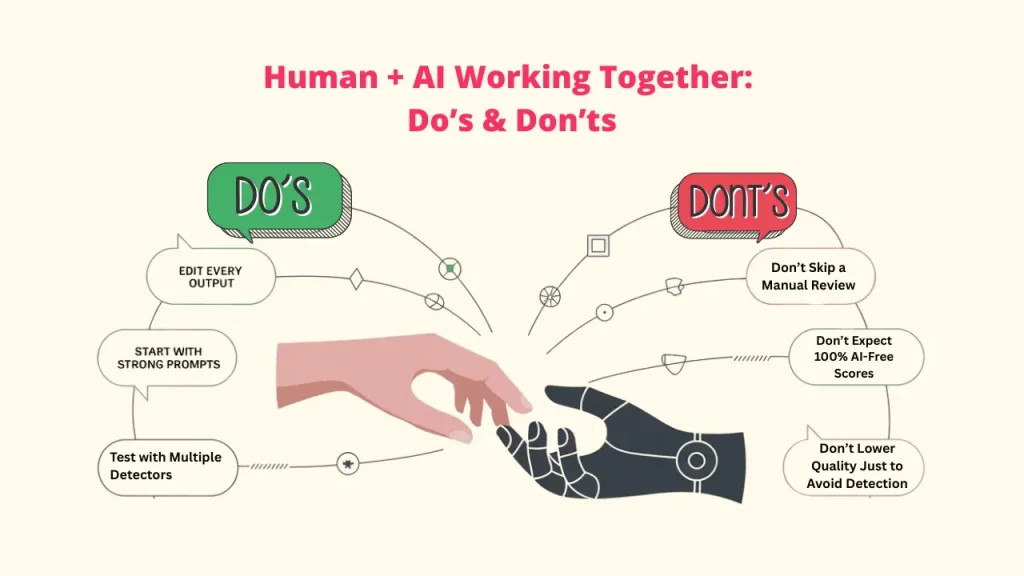
A. Do’s:
➕ Edit Every Output
No AI tool is perfect. Always read, review, and fix the content before you publish it.
➕ Start with Strong Prompts
For this, you must realize that the AI tools generate more natural AI content when given precise, comprehensive instructions.
Better input = less fixing later.
➕ Test with Multiple Detectors
Check the scores of your content using a number of AI detection tools, such as GPTZero and Copyleaks. But keep in mind that writing for people is more important than evading detectors.
➕ Use the Right Tools for Your Needs
Different AI tools have different functions. While some concentrate on rewriting, others adjust the tone.
They produce SEO-friendly content, rewrite drafts, and improve tone. Tools like Blogi are particularly useful to humanize AI content without requiring hours of editing.
B. Don’ts
❌ Don’t Skip a Manual Review
Although the AI tools are helpful, you still need to do a final check and review.
❌ Don’t Lower Quality Just to Avoid Detection
The reader experience should come first if “undetectable AI” deteriorates the content.
❌ Don’t Expect 100% AI-Free Scores
Additionally, since no detector is flawless in this one, you should concentrate on producing real, helpful, and human-friendly AI content rather than chasing scores, because even human writing is flagged.
Conclusion
Readers can instantly tell the difference between writing that feels dry and writing that feels alive.
Google rewards it. People trust it.
So AI tools can help you work faster, but your voice, your stories, and your final touch are what turn an AI draft into something real and meaningful. That human layer is what makes content memorable.
You don’t need all ten strategies right away, just start with one, apply it, then add another. Soon, humanizing your AI content will feel easy and natural.
And if you want an easier way to smooth your tone, rewrite text, or improve clarity, Blogi is a great tool to help. It supports your style while keeping your content human and clear.
In the end, your content will stand out not because AI wrote it but because you made it feel human.
FAQs About How to Humanize AI Content
Q: Will I be penalized if Google detects AI content?
A: No. Google cares more about quality than the tool you used. You won’t be penalized for using AI, but you will rank lower if your content feels generic, unhelpful, or lacks real experience, things that strong humanization helps fix.
Q: Are AI humanizer tools ethical?
A: Yes, when used the right way. It’s ethical to use tools to improve clarity, tone, or flow. It becomes unethical if you use them to plagiarize or push out large amounts of low-quality text just to trick search engines.
Q: How do I pick the right tone for my AI content?
A: Make sure the tone is consistent with both your target audience and your brand voice. Clear and authoritative works well if you sell B2B software.
Being amiable and conversational is ideal if you’re a lifestyle blogger. You can quickly change tone while maintaining your original style with tools like Blogi.
Q: How much time should I spend on Humanize AI content?
A: Plan to spend at least 50% of the time AI saved you. If AI wrote a draft in 10 minutes that would have taken you 60 minutes, invest 25-30 minutes in editing and personalizing it. You’ll still save time while dramatically improving quality.